
Evaluation Banner

Business Administration Scale (BAS)

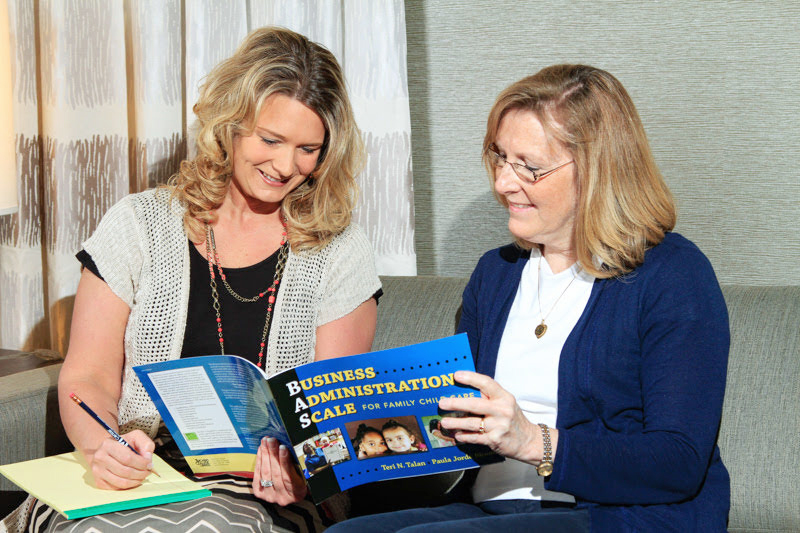
The Business Administration Scale for Family Child Care (BAS) reflects the growing professional consensus that the quality of family child care is determined by more than a provider's nurturing heart and caring interactions with children. Research on family child care indicates that providers that utilize effective professional and business practices are more likely to view family child care as a career. They are also more likely to provide a higher quality learning environment and interact more sensitively with children.
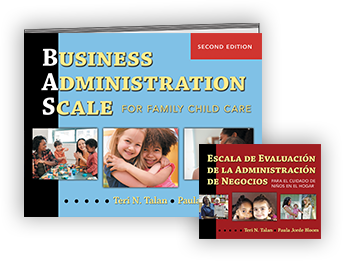
While there are several instruments available to measure the quality of provider-child interactions and the quality of the learning environment, there does not currently exist a valid and reliable instrument that measures the business practices in family child care settings. The BAS was designed to fill that void. Written by Drs. Talan and Bloom, the BAS is a reliable and easy-to-administer tool for measuring the overall quality of business and professional practices in family child care settings.

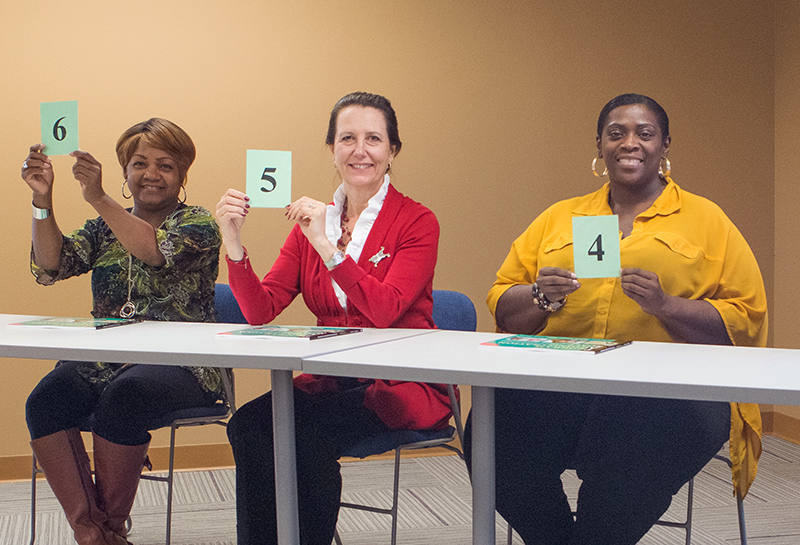
The BAS includes 37 indicator strands clustered in ten items. The instrument was constructed to complement the widely used Family Child Care Environment Rating Scale-Revised (FCCERS-R) by Harms, Cryer, and Clifford (2007). Both the BAS and the FCCERS-R measure quality on a 7-point scale and both generate a profile to guide program improvement efforts. When used together, these instruments provide a comprehensive picture of the quality of the family child care learning environment and the business practices that support the program.

Multi-Use Design

The Business Administration Scale for Family Child Care is applicable for multiple uses: program self-improvement, technical assistance and monitoring, training, research and evaluation, and public awareness. The target audience for the BAS is family child care providers and those working to monitor and improve the quality of family child care professional and business practices.

  1. Self-improvement. Because indicators are objective and quantifiable on a 7-point continuum from inadequate to excellent, providers can easily set goals to incrementally improve professional and business practices. The resulting profile can be used to benchmark a provider's progress in meeting goals over time.
  2. Technical assistance and monitoring. As part of local or state quality-enhancement initiatives, the BAS can serve as a convenient technical assistance tool providing clear guidelines for incrementally improving professional and business practices to ensure high-quality family child care.
  3. Training. For both pre-service and in-service training for providers, the BAS provides a broad overview of professional and business best practices in family child care settings, reinforcing the important role that providers play in determining the quality of care and education.
  4. Research and evaluation. For independent research studies or publicly funded quality rating systems that reward higher levels of quality, the BAS can be used to describe current levels of quality in the area of professional and business practice as well as benchmark changes over time.
  5. Public awareness. Because the BAS is written in clear language and provides a rubric of concrete examples, it can help inform stakeholders—providers, trainers, agency administrators, policymakers, parents, and resource and referral specialists—about the professional and business components of high-quality family child care.

Items, Indicator Strands, and Indicators

The BAS measures quality on a 7-point scale in 10 items. The first 9 items relate to all family child care programs. The last item (Provider as Employer) is optional depending on whether a provider employs one or more assistants or substitutes.

Each item is comprised of 2 to 5 indicator strands, and each indicator strand is comprised of four indicators on a rubric of increasing quality. After each indicator is rated, strand by strand, the item is scored on a 7-point scale from inadequate to excellent. The following is a description of the ten items:

  1. Qualifications and Professional Development assesses the educational qualifications, ongoing professional development, and peer support of the provider.
  2. Income and Benefits looks at whether the provider increases tuition and/or fees to reflect increases in the cost of living, contracts with parents for days of paid time off, and receives health, retirement, or disability benefits.
  3. Work Environment considers how well the space of the family child care home meets the needs of the enrolled children, the provider, and the provider's family. This item also assesses the adequacy of office and storage space used for the family child care business.
  4. Fiscal Management examines the availability of a current operating budget, policies and practices that ensure an adequate cash flow, evidence that standard accounting practices are adhered to, and that business income and expenses are reported to the IRS.
  5. Recordkeeping looks at whether the provider keeps track of income received, meals and snacks served to children, caregiving and other business hours worked in the home, and other business-related expenses.
  6. Risk Management assesses whether the family child care program has written policies and procedures that reduce risk, posted information about emergency drills andemergency contact numbers, and insurance coverage forvarious risks of doing business in a home.
  7. Provider-Parent Communication considers the content of the written contract the provider establishes with parents and the clarity and completeness of enrollment forms and written policies and procedures. This item also looks at the enrollment process and the variety of ways the provider communicates with parents.
  8. Community Resources looks at whether the provider makes information about community resources available to parents, facilitates a process so that a developmental screening is provided for enrolled children, and shares information with parents about child development and childrearing issues.
  9. Marketing and Public Relations evaluates the type and frequency of different external communication tools, how responsive the provider is to calls from prospective clients, and the provider's involvement in local business, civic, and religious organizations.
  10. Provider as Employer assesses the orientation of a new employee, how frequently assistants meet with the provider to plan activities and share observations, and whether the provider pays employees at least the minimum wage, withholds appropriate taxes, and pays social security taxes.

The BAS is currently one of the assessments being used in Quality Counts, the Illinois Quality Rating System. INCCRRA sponsors a workshop, Getting Ready for the BAS, for family home providers interested in learning more about the instrument. If you are interested in this training opportunity, you can download a workshop schedule. For additional information about the BAS, contact Jill Bella, Director of Special Projects at (800) 443-5522, ext. 5059 or jill.bella@nl.edu.

Copyright
Back to Top | Search Site | Contact Us